Two Ways to Solve the Same Problem: Consulting-Led GRC and JEWELS SAFE GRC™
Date: August 1, 2026 Primary Sources: Accenture Risk consulting (Accenture) · Cloudflare Network (Cloudflare)
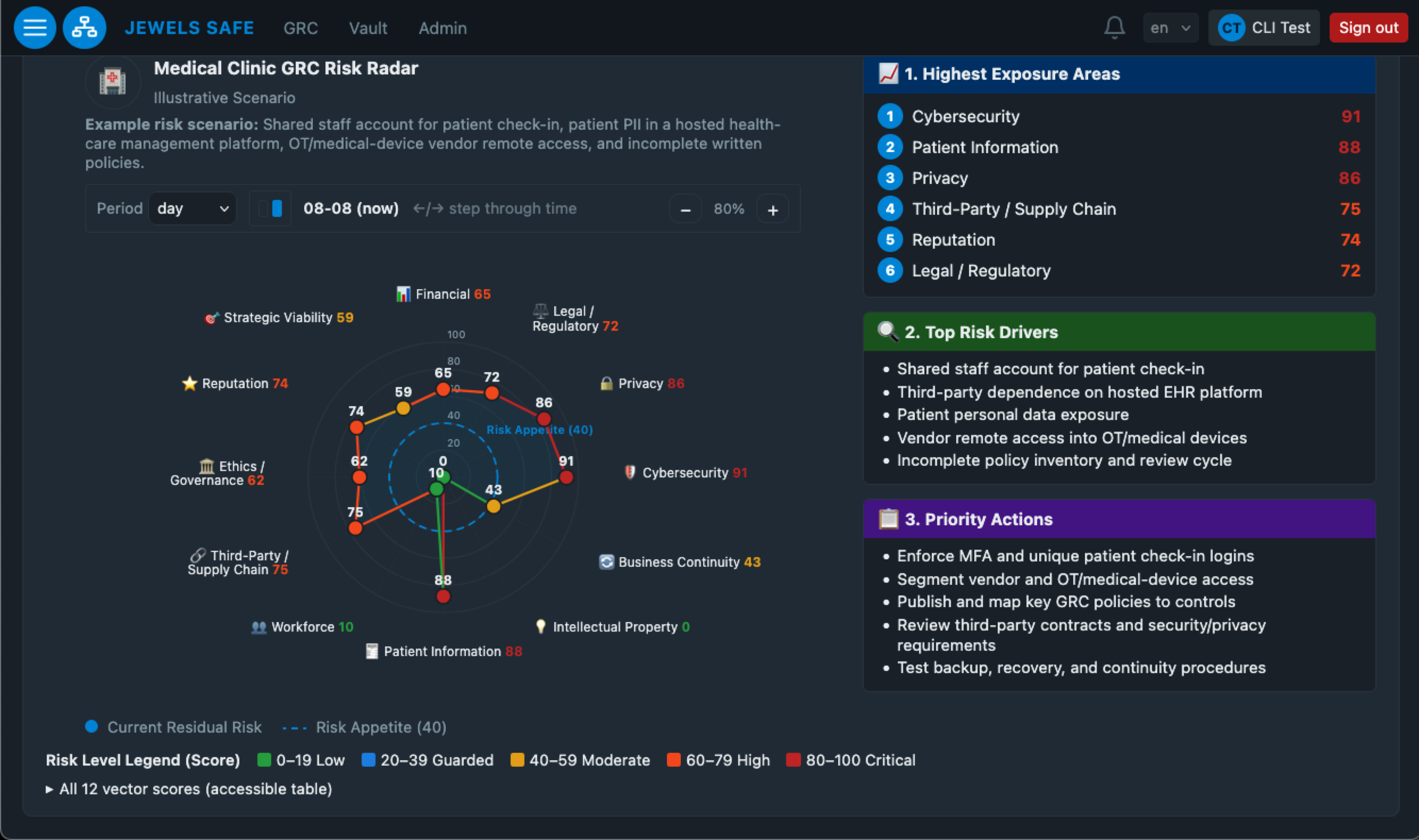
JEWELS SAFE GRC Organizational Risk Radar — illustrative product design concept. The organization, scenario, and scores shown are fictional and are presented for design purposes only.
Executive Summary
- The premise is shared. Accenture reports that 83% of Chief Risk Officer respondents to their latest Risk Study say complex interconnected risks are emerging more rapidly. (Accenture)
- Two delivery models, not one contest. Consulting-led transformation and continuous GRC delivered as software solve the same need in different ways, for different buyers.
- The gap is economic, not technical. Community banks, healthcare providers, government agencies, nonprofits, education, and the MSPs who serve them carry real obligations with no Chief Risk Officer, no risk team, and no transformation budget.
- Status: JEWELS SAFE GRC™ is under development. No portion is generally available today, and this post announces no pricing, release dates, or customer commitments.
The Shared Premise
Governance, risk, and compliance is no longer a filing-cabinet exercise. It is a board-level problem, and the largest professional services firms in the world have built substantial practices around it.
Accenture's risk consulting practice puts the case plainly. On its Risk consulting page, Accenture states that 83% of Chief Risk Officer respondents to their latest Risk Study say complex interconnected risks are emerging more rapidly, and that 72% of CROs say their risk management capabilities have not kept pace. (Accenture) (Retrieved August 2026.)
We agree — and the fact that a global consultancy can build a practice this large is itself evidence that the need is real and growing. So the question here is not whether organizations need serious governance capability, but how it gets delivered, and to whom.
There are two answers. Consulting-led transformation is one. Continuous GRC delivered as software is the other. They are not the same product, they do not serve the same buyer, and they are not in a fight.
What the Consulting Model Does Well
Accenture's page describes risk and compliance transformation delivered as consulting services: regulatory change management, automated risk-control strategies, financial and regulatory reporting, enterprise fraud risk management, customized risk models, "know your customer" (KYC) and anti-money laundering (AML) technology transformation, and AI-based credit-risk analysis. It names technology partners including Quantexa, Appian, ServiceNow, Informatica, Splunk, Celonis, and Workiva, and addresses Chief Risk Officers, with a strong emphasis on banking and financial services. (Accenture)
Accenture publishes results for that work. The same page states that automation, data streamlining, and exception-based risk management can reduce the cost of core risk-management processes by up to 50%; that its approach can reduce AML alerts by 25–40% and KYC reviews by 15–35%; that a quality control framework produced a 95–98% quality rating across deliveries; and that AI-based remediation can deliver 50–70% in cost savings. (Accenture) (Retrieved August 2026.)
That is a serious offering aimed at a serious buyer: a large institution with a Chief Risk Officer, an in-house risk organization, a regulatory examination calendar, and the budget for a multi-year transformation program. For that organization, engaging a firm of that scale is a rational decision, and we would not argue otherwise.
Here is the gap, and it has nothing to do with the quality of the consulting.
Who That Model Does Not Reach
Most organizations cannot buy a global consulting engagement. A community bank with four branches has the same examiners as a regional institution. A rural hospital carries the same patient privacy obligations as a hospital system. A county agency, a credit union, a nonprofit, a school district, a manufacturer — each carries formal, auditable obligations from regulators, insurers, and customers, and most have no Chief Risk Officer, no risk team, and no transformation budget. The managed service providers who serve them inherit those obligations on their customers' behalf, usually with a handful of technicians.
These are the organizations White Cloud Security has served for more than a decade with Trust Lockdown™. They are not underserved because their risk is smaller, but because the delivery model that serves large institutions is not economically reachable for them.
A Different Delivery Model: What JEWELS SAFE GRC Is
JEWELS SAFE GRC™ — Secure Asset Framework Enforcement for Governance, Risk, and Compliance — is our answer to that gap: continuous, explainable GRC delivered as a subscription product rather than as an engagement. It connects policy to measurement, and measurement to executive decision-making.
That chain starts with the policies themselves. Governance turns an organization's objectives, obligations, and risk appetite — how much exposure the board is willing to carry — into affirmative policies: statements of what is required, written concretely enough to be measured rather than merely asserted. Everything downstream depends on it. Controls and conditions give the policies effect, evidence demonstrates they are operating, and risk scores summarize the result.
- Affirmative, living policies — stated as concrete, measurable requirements, then versioned, reviewed, approved, and continuously maintained rather than authored once and filed.
- Identified controls and conditions — each policy mapped to the controls, conditions, owners, systems, assets, vendors, evidence, laws, regulations, and standards that give it effect.
- Continuous monitoring and measurement of whether controls are actually operating, with manual and automated evidence collection.
- Findings, exceptions, and corrective actions tracked as records, not as items in a report.
- Risk scoring against appetite — inherent and residual organizational risk calculated from those underlying records and read against the risk appetite the organization set.
- An executive risk radar — one view of exposure across twelve dimensions of business impact.
For more than a decade our Trust Lockdown products have answered one disciplined question on the endpoint: is this software approved, and is it permitted to run? Trust Lockdown is Default-Deny, Zero-Trust application control — it identifies files by handprint (multiple cryptographic hashes plus file length) and by administrator-approved code-signing certificates in Trust Profiles, rather than by behavioral guesswork. JEWELS SAFE GRC applies that discipline to the whole organization.
This is meant to coexist with consulting work, not replace it. An organization that engages advisors for a framework assessment or examination readiness still needs somewhere for that work to live and keep running afterward.
Explainable and Auditable by Design
Every score JEWELS SAFE GRC produces is intended to be traceable to the records beneath it — the policies, controls, conditions, evidence, measurements, findings, exceptions, and corrective actions that produced it. An executive can move from a single number on the risk radar shown above to the control that failed and the evidence behind it. Where AI assists the analysis, its findings are presented for human review and approval.
That is deliberate. JEWELS SAFE GRC produces explainable, auditable risk scores — not opaque AI-generated numbers. If an auditor cannot trace a score back to the policies, controls, and evidence that produced it, it is not a defensible risk assessment.
SAFE GRC: What, Where, Who, Why, How, When
JEWELS SAFE GRC organizes governance around the six dimensions of our SAFE GRC™ (Secure Asset Framework Enforcement) model:
- What asset, information, system, process, or requirement is governed.
- Where it is located, stored, processed, transferred, or permitted.
- Who owns, operates, approves, reviews, or accesses it.
- Why the activity, access, exception, or control is justified.
- How it may be accessed, used, changed, monitored, or protected.
- When it is authorized, reviewed, measured, renewed, or terminated.
A Multidimensional View of Governance
JEWELS SAFE GRC is built on a multidimensional 'hypercube' data model. Governance data is inserted in real time and evaluated continuously, so policies are applied to risk and compliance analysis and scoring as the underlying records change, and, where possible, governance policy violations are prevented rather than discovered at the next audit.
The practical value is this. Conventional compliance tools evaluate one policy, control, or framework at a time. Multidimensional analysis examines many at once — assets, controls, risks, owners, vendors, evidence, and time — so the same records can be read by department, by regulation, or by quarter without duplicating the data.
Built for the Cloudflare Edge, Delivered Globally
JEWELS SAFE GRC is being designed as a cloud-native service on the Cloudflare Edge, where we already run production Workers and Zero Trust services. Cloudflare reports a network spanning 337 cities, with 95% of the world's Internet-connected population within 50 milliseconds of a Cloudflare data center. (Cloudflare) (Retrieved August 2026.) That gives us global infrastructure without regional data centers of our own, and lets us provision isolated customer environments without new hardware per subscription — with the flexibility data-residency and digital-sovereignty requirements demand.
Governance also only works when people can read it. JEWELS SAFE GRC will use the multi-language capability built for our Trust Lockdown dashboard, which currently operates in 38 languages with additional regional dialects, so policies, findings, and executive reports reach the employees, auditors, regulators, and partners who must act on them.
A Fair Comparison
Neither column below is a verdict. Each describes what a delivery model is built to optimize.
| Dimension | Consulting-led transformation (per Accenture's Risk consulting page) | JEWELS SAFE GRC (in development) |
|---|---|---|
| Primary buyer | Chief Risk Officers and risk leaders; emphasis on banking and financial services | Owners, executive directors, compliance officers, IT managers, and the MSPs serving them |
| Delivery model | Consulting and technology transformation services, with named partners including Quantexa, Appian, ServiceNow, Informatica, Splunk, Celonis, and Workiva | Subscription software on the Cloudflare Edge, in 38 languages with additional regional dialects |
| Engagement shape | Transformation programs spanning regulatory change, risk-control automation, reporting, fraud management, custom risk models, KYC/AML, and credit risk | Stand up a serverless regional or global tenancy at setup — no new hardware per subscription — then continuous risk-governance scoring driven by living-policy changes and automated evidence inputs |
| Where risk insight comes from | Accenture's Risk Study research, its risk models, and the technologies it implements | The organization's own policies, controls, evidence, measurements, and findings |
| Economic reach | Organizations able to engage a global consultancy | Organizations with obligations but no risk department or transformation budget |
| What the organization holds afterward | Transformed processes, implemented technology, and reporting capabilities, as described on the page | A living record of its own governance that keeps measuring itself |
We are not claiming consulting work ends at delivery — Accenture's page describes automation and technology transformation intended to keep operating. The distinction we draw is about who runs the measurement day to day.
What This Means
If your organization has a Chief Risk Officer and a transformation budget, the consulting model is available to you, it works, and firms like Accenture publish results for it.
If it does not — if compliance is one of six responsibilities on someone's desk, and the annual audit is the only time anyone looks at the controls — then serious governance has been priced out of reach. That is the gap JEWELS SAFE GRC is being built to close: continuous measurement, explainable scores, and an auditable record, delivered as software to organizations that carry real obligations without a department to carry them.
Key Takeaways
- Consulting-led transformation and continuous GRC software are two delivery models for the same need, suited to different buyers.
- The consulting model works for institutions with a Chief Risk Officer, a risk team, and a transformation budget. Most organizations carrying formal obligations have none of those three.
- JEWELS SAFE GRC continuously evaluates the multidimensional 'hypercube' data model to apply policy as the underlying records change, preventing violations in the moment where possible rather than discovering them at the next audit.
- Governance turns organizational objectives, obligations, and risk appetite into affirmative, measurable policies. Every risk assessment should then be traceable to the policies, controls, conditions, and evidence that produced it. A risk score that cannot be decomposed cannot be reliably acted upon, assigned to an accountable owner, or defended to auditors and regulators.
References
- Accenture — Risk consulting (retrieved August 2026)
- Cloudflare — The Cloudflare global network (retrieved August 2026)
Further Reading
- GRC Information Protection Basics
- WCS Benefits vs. MDR / EDR Benefits
- STRIDE vs. a Zero-Trust Security Model
- Zero-Trust Asset Protection for Digital Sovereignty
- Cybersecurity for the Agent Era
Trademark and Non-Affiliation Notice
JEWELS SAFE GRC™ is under development. No portion of the product is generally available today, and this post announces no pricing, release dates, or customer commitments.
Accenture is a trademark of Accenture Global Services Limited. Cloudflare is a trademark of Cloudflare, Inc. Quantexa, Appian, ServiceNow, Informatica, Splunk, Celonis, and Workiva are trademarks of their respective owners. None of these companies is affiliated with, and none endorses, White Cloud Security, Inc. or JEWELS SAFE GRC™. All statements about Accenture here are drawn from Accenture's own published material, linked above and retrieved in August 2026. JEWELS SAFE GRC™, SAFE GRC™, and Trust Lockdown™ are trademarks of White Cloud Security, Inc.